![10 Best DMCA Ignored Hosting In 2026 – [Tested & Reviewed]](https://bestdmcaignoredhosting.com/wp-content/uploads/2026/07/best-dmca-ignored-hosting-BLLACK-logo-png.png)
A website owner in Europe gets a takedown notice from a US based copyright holder. Their hosting provider suspends the site within hours, even though the owner believes they had every right to publish the content. This exact situation is why so many people start searching for DMCA ignored hosting in the first place.
When a website hosts copyrighted material without permission, the hosting company may receive a formal request to remove that material. These requests are usually sent under the Digital Millennium Copyright Act, better known as the DMCA. Most traditional hosting companies follow these rules strictly, since ignoring a valid notice can put their own business at legal risk.
Because of this strict enforcement, many website owners look for DMCA ignored hosting, which is typically offered by offshore hosting providers operating outside the United States. But this raises an important question that is not always easy to answer: is DMCA ignored hosting actually legal?
The answer depends on several factors, including where the server is physically located, which country’s laws apply to the hosting company, and what kind of content is actually being hosted.
This guide breaks down each of these factors so you can understand exactly where the legal lines are drawn.
What Is DMCA?
The DMCA is the foundation of how copyright complaints work online, and understanding it is the first step to understanding why offshore hosting exists at all. Before looking at DMCA ignored hosting, it helps to know what the original law actually does.
The Digital Millennium Copyright Act is a copyright law introduced in the United States in 1998. It was designed to protect digital content such as music, movies, software, images, and written material from unauthorized distribution on the internet.
The law also gives hosting providers a legal shield, commonly called safe harbor protection, as long as they respond properly to valid complaints.
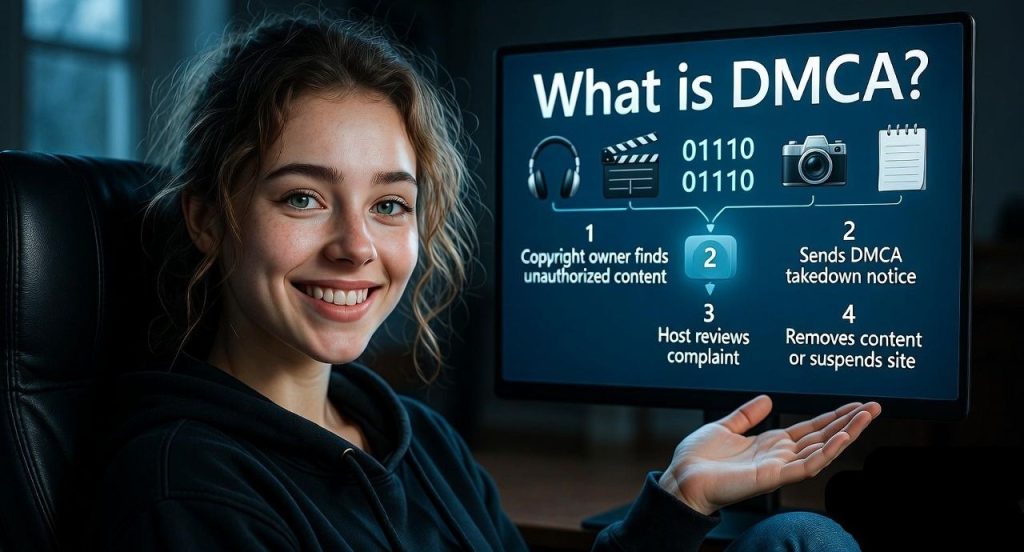
Under this law, copyright owners can send a DMCA takedown notice if their content appears on a website without permission. Hosting companies that operate in the United States usually follow a clear, structured process when they receive such complaints. Typically, the process works like this:
- A copyright owner finds their content being used without permission.
- They send a DMCA takedown notice to the hosting provider.
- The hosting company reviews the complaint for validity.
- The provider removes the content or temporarily disables the website if the complaint appears legitimate.
This system allows hosting companies to avoid legal liability for content posted by their users, while also giving copyright owners a fast way to protect their work without going to court every time.
Why the Safe Harbor Provision Matters?
Before going further into what DMCA ignored hosting actually means, it is worth understanding why US hosting providers bother responding to takedown notices at all. The reason comes down to a single legal protection that offshore providers simply do not have access to in the same way.
The safe harbor provision, found under Section 512 of the DMCA, protects hosting companies from being held liable for copyright infringing content uploaded by their users, as long as the provider follows a specific set of rules. These rules include removing infringing content quickly once notified, not having actual knowledge of the infringement beforehand, and not gaining direct financial benefit from the infringing activity while having the right to control it.
This is the real reason US hosting companies act so quickly on DMCA notices. It is not just about respecting copyright law in principle, it is about preserving their own legal immunity. If a hosting provider ignores valid notices repeatedly, it can lose this safe harbor protection entirely and become directly liable for its users’ actions, which opens the door to lawsuits and damages.
Offshore hosting providers outside US jurisdiction generally do not need this specific protection, because the DMCA does not automatically apply to them in the first place. This is a major reason why their complaint handling looks so different from US based hosts. It is not that they are breaking the law by ignoring DMCA notices, it is that the law was never designed to reach them directly.
What Is DMCA Ignored Hosting?
Once you understand safe harbor, the marketing term “DMCA ignored hosting” starts to make a lot more sense. This section explains what the term actually means in practice, rather than just what it implies.
DMCA ignored hosting refers to web hosting services that claim they do not automatically act on DMCA takedown requests. These providers usually operate in offshore locations, meaning their servers and business registration are located outside the United States. Because the DMCA is a US law, hosting providers in other countries are not legally required to follow it in the same way US companies are.
However, this does not mean the provider completely ignores every complaint that comes in. Most offshore hosting companies still follow their own local regulations and internal policies when dealing with copyright issues, abuse reports, or content disputes. The term “DMCA ignored hosting” is largely a marketing phrase used by offshore hosting providers to describe a more flexible, less automatic approach to copyright complaints, not a guarantee of complete immunity from every kind of legal action.
How DMCA Laws Apply to Hosting Providers?
Jurisdiction is the single most important concept in this entire topic, and it explains almost everything about why offshore hosting behaves differently from US hosting. This section breaks jurisdiction down by region and by role.
Understanding the legality of DMCA ignored hosting requires knowing how copyright laws apply differently depending on where a hosting company is based and where its servers physically sit.
DMCA Compliance in the United States
Hosting providers located in the United States must comply with the DMCA if they want to keep their safe harbor protection. If they ignore valid copyright complaints, they risk losing that protection and can face direct legal liability, including lawsuits from copyright holders seeking damages. Because of this risk, US based hosting companies almost always respond quickly to DMCA notices, often within hours.
Copyright Policies in Other Countries
Many countries have their own copyright laws, which may not follow the same notice and takedown procedure as the DMCA. Some countries require a formal court order before content can be removed, while others allow hosting providers to handle complaints internally without any standardized legal process at all. This difference in legal systems is the primary reason offshore hosting services exist and continue to attract customers who feel the DMCA process is too aggressive or too easily abused.
Role of Hosting Providers
Even offshore providers must operate within the laws of the country where their servers are physically located and where their business is legally registered. They may ignore DMCA notices specifically, since that law does not bind them directly, but they cannot ignore the copyright, criminal, or content laws of their own jurisdiction. A provider based in the Netherlands, for example, still has to follow Dutch and EU law, even if it never responds to a single DMCA notice from a US copyright holder.
Is DMCA Ignored Hosting Legal?
This is the question most people actually came here to answer, so it deserves a direct and honest response rather than a vague one. The short version is that the hosting model itself is generally legal, but that legality has real limits depending on what is being hosted.
In general, DMCA ignored hosting itself is not illegal. The DMCA is a law created by the United States government, which means it mainly applies to hosting providers located in the United States or otherwise operating under US jurisdiction.
Hosting providers located in other countries are governed by their local copyright laws, not the DMCA, so they are not legally required to respond to DMCA takedown notices in the same automatic way US hosting companies do.
However, legality also depends heavily on the content actually hosted on the server. Even if a provider advertises DMCA ignored hosting, the website owner is still responsible for ensuring that the content follows the laws of the country where the server is located, and often the laws of the country where the content owner lives as well.
For example, hosting itself may be entirely legal, while certain types of copyrighted content hosted on that same server could still be illegal under local laws, and governments can still take action if those local laws are violated regardless of what the hosting provider’s DMCA policy says.
Civil Liability vs Criminal Liability
One detail that often gets lost in this discussion is the difference between civil copyright disputes and criminal liability, and this distinction changes everything about how much protection offshore hosting actually offers.
Most DMCA takedown situations are civil matters. A copyright holder claims their content was used without permission and asks for it to be removed, and in the worst case they can sue for financial damages. Choosing a hosting provider that does not automatically comply with DMCA notices does not make a civil copyright dispute disappear, it simply removes the fastest and easiest enforcement path, meaning the copyright holder may need to pursue legal action directly against the website owner instead of relying on the host to remove the content.
Criminal liability is a completely different category and offshore hosting offers essentially no protection here at all. Activities like large scale commercial piracy, distribution of malware, fraud, or hosting illegal content such as material involving minors can trigger criminal investigation regardless of where the server is physically located or what the hosting provider’s complaint policy looks like.
International law enforcement cooperation, mutual legal assistance treaties, and cross border investigations mean that a server sitting outside US jurisdiction is not automatically outside the reach of criminal law. Website owners should never assume that a DMCA ignored hosting label provides any shield against criminal exposure.
Countries Where DMCA Ignored Hosting Is Common
Certain countries have built a reputation in the offshore hosting industry, usually because of a combination of infrastructure quality, favorable regulation, and legal distance from US enforcement. Knowing why each location is popular helps explain the bigger jurisdiction picture discussed above.
- Netherlands: The Netherlands has a large internet infrastructure and major data centers, backed by some of the best connectivity in Europe. Some offshore hosting companies operate there because Dutch and EU procedures differ from the US notice and takedown system, even though EU copyright rules still apply.
- Russia: Some hosting providers in Russia offer offshore hosting services that respond differently to copyright complaints compared to US companies, partly due to limited cooperation with US legal requests in recent years.
- Bulgaria: Bulgaria has appeared in offshore hosting discussions because certain providers operate servers there with more flexible internal policies, while still technically being subject to EU copyright directives as an EU member state.
- Hong Kong: Hong Kong has historically been a popular hosting location because of strong internet connectivity and hosting regulations that are somewhat independent from mainland Chinese and US frameworks.
- Seychelles: Some hosting companies register their businesses in jurisdictions like Seychelles because of privacy friendly business regulations and minimal reporting requirements, which appeals to providers who want to limit how much operational detail is publicly disclosed.
- Moldova: A few offshore hosting providers operate servers in Moldova due to its regulatory environment, which has historically had less aggressive enforcement cooperation with US copyright holders.
It is important to remember that laws change over time, and not every provider registered in these countries actually offers DMCA ignored hosting. Some simply have data centers there while still complying with DMCA requests voluntarily as a matter of business policy.
Legal Risks of Using DMCA Ignored Hosting
Flexibility on paper does not always translate into safety in practice, and this section covers the risks that many website owners do not think about until they actually run into them.
Although DMCA ignored hosting can offer more flexibility around copyright complaints, there are still real risks that website owners should carefully weigh before committing to this hosting model.
- Copyright Enforcement: Even when a hosting provider ignores DMCA notices, copyright owners may still take legal action directly against the website owner, especially if the website operates internationally or has any connection to a jurisdiction where enforcement is stronger.
- Jurisdiction Issues: Different countries have different legal systems, and a website that appears perfectly legal in one country may still violate copyright or content laws in another, particularly if the content owner or the audience is based somewhere with stricter rules.
- Provider Policies: Many offshore hosting providers still enforce certain baseline rules and may suspend websites involved in clearly illegal activities such as fraud, malware distribution, or scams, regardless of how they handle standard DMCA complaints.
- Reputation Concerns: Some offshore hosting companies have weaker reputations due to inconsistent support quality or less reliable infrastructure, which is a practical business risk separate from the legal risk.
Risks Beyond the Hosting Layer
Hosting is only one link in the chain that keeps a website online, and this is a gap most articles on this topic skip entirely. Even a hosting provider that fully ignores DMCA complaints cannot protect a website from pressure applied at other points in that chain.
- Domain Registrars: Domain registrars are a separate business from hosting providers and often operate under different jurisdictions with their own abuse policies. A registrar can suspend or seize a domain name in response to a legal complaint even if the hosting provider itself never takes any action, which can take a website offline instantly regardless of server location.
- Payment Processors: Payment processors and banks tend to be far more risk averse than hosting providers, since they operate under strict financial regulations. A processor can freeze funds or terminate a merchant account if a website is linked to repeated copyright complaints or flagged content, cutting off revenue even when the hosting itself remains untouched.
- Search Engine De-indexing: Search engines like Google accept their own copyright removal requests, separate from hosting level takedowns. A website can remain fully online on DMCA ignored hosting while still disappearing from search results entirely, which severely limits its practical reach and traffic.
- Upstream Network Blocking: Hosting providers rely on upstream internet transit providers and network operators to actually deliver their traffic to the wider internet. In some cases, upstream providers have blocked or throttled traffic to specific IP ranges associated with repeated abuse complaints, effectively limiting accessibility even when the direct hosting provider takes no formal action at all.
Understanding these additional pressure points is important, because focusing only on the hosting provider’s DMCA policy gives an incomplete picture of the actual risk landscape.
DMCA Ignored Hosting vs Standard Hosting
Seeing the two hosting models side by side makes the practical differences much easier to understand than reading about them in separate paragraphs.
| Feature | Standard Hosting | DMCA Ignored Hosting |
|---|---|---|
| Copyright Enforcement | Strict compliance | Flexible policies |
| Server Location | US / EU | Offshore countries |
| Complaint Handling | Immediate response | Depends on provider |
| Risk of Suspension | Higher | Usually lower |
| Legal Framework | DMCA law | Local jurisdiction |
| Payment Processing Risk | Lower | Often higher due to processor caution |
This difference is why some website owners choose offshore hosting environments, particularly when they operate in gray areas where a single takedown notice could otherwise mean an instant suspension.
Who Typically Uses DMCA Ignored Hosting?
The demand for this type of hosting comes from a fairly specific range of website categories, most of which share a common need for content stability. Understanding who actually uses this hosting model helps put the legal discussion into practical context.
Several types of websites commonly look for offshore hosting environments, including:
- File hosting platforms
- Streaming websites
- Torrent related services
- Privacy focused communities
- Independent publishing platforms
Some researchers and archival projects also use offshore hosting to maintain long term content availability, particularly when their material could otherwise be removed due to disputed ownership claims or politically sensitive subject matter.
Important Things to Consider Before Using It
Choosing this kind of hosting is not a decision to make lightly, since the responsibility for the content ultimately stays with the website owner no matter what the provider’s policy says. Before committing, a few practical factors deserve careful attention.
- Understand Local Laws: The legality of hosted content depends on the laws of the country where the server is located, not just on the hosting provider’s marketing claims.
- Research the Hosting Provider: Not all offshore hosting providers are equally reliable. It is important to choose companies with stable infrastructure, transparent policies, and a track record of actually keeping websites online long term.
- Check Terms of Service: Many providers still prohibit certain activities such as hacking, phishing, or malware hosting, even while advertising themselves as DMCA ignored.
- Evaluate Long Term Stability: Websites should consider network quality, uptime reliability, and technical support quality when choosing a hosting provider, since flexible copyright policies mean little if the server is frequently down.
How to Choose a Reliable Offshore Hosting Provider?
Not every provider that advertises DMCA ignored hosting actually delivers on that promise consistently, so choosing carefully matters more here than with standard hosting. This section walks through the specific things worth checking before signing up.
Selecting a reliable hosting company requires careful research rather than picking the first result from a search engine. Some important factors to evaluate include:
- Clear information about server locations, since vague or hidden location details often signal a provider that is not fully transparent about its jurisdiction.
- Professional data center infrastructure, including redundancy, network capacity, and physical security, rather than a small operation reselling capacity from another provider.
- Transparent privacy policies, clearly explaining what customer data is collected, how long it is retained, and under what circumstances it might be shared.
- Reliable customer support, ideally available across multiple channels and time zones, since offshore providers can be harder to reach during disputes.
- Stable network performance, verified through independent uptime monitoring rather than the provider’s own marketing claims.
- A documented history of handling complaints, which can often be checked through independent reviews, forums, and community discussions rather than the provider’s own website.
A trustworthy hosting provider should offer both flexibility around copyright complaints and genuine technical reliability, since one without the other defeats the purpose of switching to offshore hosting in the first place.
FAQs
Is DMCA ignored hosting completely legal in every country?
No. The hosting model itself is generally legal because the DMCA is a US law that does not automatically bind foreign providers, but the content hosted must still comply with the local laws of the server’s country and often the laws of the countries where the content owner and audience are located.
Can a DMCA ignored host still be sued for copyright infringement?
The hosting provider is less likely to face direct US legal action due to limited jurisdiction, but the website owner can still be sued directly by the copyright holder, particularly if they have any presence, assets, or business activity within reach of that jurisdiction.
Does DMCA ignored hosting protect against criminal charges?
No. Criminal matters such as fraud, malware distribution, or illegal content are handled very differently from civil copyright disputes, and offshore hosting offers essentially no protection against criminal investigation or prosecution.
Why do some offshore providers still suspend accounts despite advertising DMCA ignored hosting?
Most providers still enforce their own terms of service, which usually prohibit clearly illegal activity like hacking, phishing, or malware distribution, regardless of their copyright complaint policy.
Is it legal to host copyrighted movies or music on DMCA ignored hosting?
Hosting the infrastructure itself may be legal depending on jurisdiction, but distributing copyrighted movies or music without permission is typically still a copyright violation under the laws of most countries, including wherever the server is actually located.
How is DMCA ignored hosting different from offshore hosting in general?
Offshore hosting simply refers to hosting located outside your home country, which does not automatically mean copyright complaints are ignored. DMCA ignored hosting specifically refers to a provider’s stated policy of not automatically acting on DMCA takedown notices, which is a narrower and more specific claim.
Conclusion
DMCA ignored hosting refers to offshore hosting services that do not automatically follow United States DMCA takedown procedures, and in most cases this hosting model itself is legal. Because the DMCA is a US law, hosting providers located in other countries are generally governed by their own local copyright regulations rather than by US enforcement mechanisms.
That said, legality of the hosting model does not automatically extend to legality of the content itself. The material published still has to comply with the laws of the country where the server operates, and website owners remain personally responsible for what they publish no matter how flexible their hosting provider’s complaint policy appears to be.
Risks can also appear outside the hosting layer entirely, through domain registrars, payment processors, and search engines, all of which operate under their own separate rules.
Understanding how international copyright law, jurisdiction, and hosting regulations actually interact is the real key to making an informed decision.
Rather than treating DMCA ignored hosting as a blanket legal shield, website owners are better served by researching their specific content, their specific audience, and the specific jurisdiction of any provider they are considering before making a final choice.