![10 Best DMCA Ignored Hosting In 2026 – [Tested & Reviewed]](https://bestdmcaignoredhosting.com/wp-content/uploads/2026/07/best-dmca-ignored-hosting-BLLACK-logo-png.png)
When choosing a web hosting service, most people never think twice about where their server physically sits. But a growing number of website owners are looking beyond their home country and choosing servers located elsewhere, a practice known as offshore hosting.
Offshore hosting is often linked to privacy protection, international business expansion, and more flexible content policies. Because of this reputation, a common question comes up again and again: is offshore hosting actually legal, or does it put website owners at legal risk?
The short answer is that offshore hosting is legal in almost every case, but the full answer depends on three things: the country where the server is located, the laws that apply to the hosting provider, and, most importantly, what content or activity the website actually involves. This guide breaks down exactly how offshore hosting laws work, where the legal risks actually come from, and how to use offshore hosting safely and responsibly.
What Is Offshore Hosting?
Offshore hosting refers to hosting a website, application, or data on servers located in a different country than the website owner’s country of residence or business registration.
For example, a business owner in India might choose to host a website on servers located in the Netherlands, Switzerland, or Singapore instead of using a local Indian hosting provider.
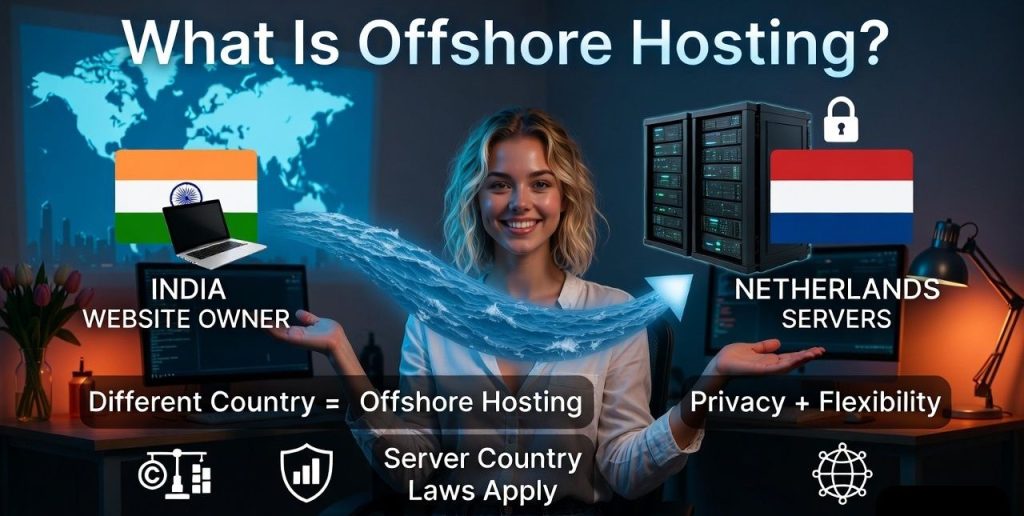
In this case, the website is considered offshore hosted, even though the owner, the customers, and the business itself may all be based elsewhere.
Offshore hosting is not one single product. It usually comes in a few different forms:
- Offshore shared or VPS hosting, where the provider owns the hardware and simply rents out capacity. This is the fastest and cheapest way to get started.
- Offshore dedicated servers, where you rent an entire physical machine located in the offshore data center, without owning the hardware yourself.
- Offshore colocation hosting, where you own the physical server and simply rent rack space, power, cooling, and bandwidth from a data center abroad. This option requires shipping hardware internationally and is usually chosen by businesses with specific compliance or performance needs.
The main reason offshore hosting behaves differently from local hosting is legal jurisdiction. When a website is hosted in another country, the hosting provider is bound by the laws and regulations of the country where its servers physically operate, not the laws of the country where the website owner lives.
This affects how content takedown requests are handled, how user data is protected, and how disputes are resolved.
How Hosting Laws Work Internationally?
To understand whether offshore hosting is legal, it helps to understand how the internet’s legal framework actually functions across borders.
Server Location and Jurisdiction
The most important legal factor in hosting is server location. Offshore Hosting providers must comply with the laws of the country where their infrastructure is based, including regulations on copyright, cybersecurity, data protection, and online commerce. If a website is hosted on servers in the Netherlands, Dutch and EU law generally governs how the hosting provider must respond to legal requests, not the laws of the country the website owner lives in.
Website Owner Responsibility
Even when using offshore hosting, the website owner does not escape legal responsibility for their own content or actions. Choosing a server in another country does not make copyright violations, fraud, or cybercrime legal. Many people mistakenly believe that offshore hosting creates a legal shield around illegal activity. In reality, it only changes which country’s hosting laws apply to the server itself, not which laws apply to the person publishing the content.
Cross-Border Legal Cooperation
The internet operates globally, but law enforcement does not stop at borders. Several international mechanisms allow governments to act on cross-border hosting issues:
- Mutual Legal Assistance Treaties (MLATs) allow one country’s authorities to formally request cooperation from another country’s courts or agencies, for example to obtain server logs or user data connected to a criminal investigation.
- The Budapest Convention on Cybercrime is an international treaty that many countries have signed to standardize how cybercrime, hacking, and online fraud are investigated and prosecuted across borders.
- Copyright treaties, such as those coordinated through the World Intellectual Property Organization (WIPO), mean that copyright holders can often pursue takedown requests internationally, even when a server sits outside their home country.
This is why serious crimes, large scale piracy operations, or major fraud cases can still result in international action, even against offshore hosted infrastructure, while smaller, routine hosting choices rarely attract this level of scrutiny.
Is Offshore Hosting Legal?
In the vast majority of situations, offshore hosting itself is completely legal.
Hosting a website in another country simply means the website’s data lives on servers outside the owner’s home country. This is a routine business decision.

Large enterprises, e-commerce platforms, media companies, and privacy focused projects all use offshore hosting to reach global audiences, improve performance for international users, or operate under a more favorable regulatory environment.
That said, the legality of any specific offshore hosting setup depends on two things:
- The laws of the country where the server is located. The hosting provider must operate within those laws, and those laws determine how the provider responds to complaints, takedown notices, or legal orders.
- The type of content or activity hosted on the website. Server location does not override content laws. Hosting copyrighted material without permission, running phishing operations, distributing malware, or facilitating fraud remains illegal in nearly every jurisdiction in the world, regardless of where the server physically sits.
So, offshore hosting as a method is legal. What you host on it is what determines whether you are operating within the law.
When Offshore Hosting May Create Legal Issues
While offshore hosting is generally legal, certain situations can still create real legal exposure for website owners:
- Copyright infringement. Hosting copyrighted material, whether it is software, movies, music, or written content, without a license or permission can still lead to takedown notices, legal complaints, or lawsuits from rights holders, even if the offshore provider is slow to respond.
- Illegal online services. Websites involved in fraud, phishing, counterfeit sales, unlicensed gambling, or the sale of illegal goods can face legal action from multiple jurisdictions at once, since these activities are almost universally prohibited.
- Data protection violations. Regulations such as the EU’s General Data Protection Regulation (GDPR) can still apply to a website owner based on where their users are located, not just where the server sits. A business serving EU customers may need to follow GDPR rules even if its servers are hosted in a non-EU country.
- Ignoring valid legal orders. Courts and regulators can issue legitimate takedown orders or data requests. Ignoring these, especially in cases involving criminal activity, can escalate a civil matter into a much more serious legal problem for both the hosting provider and the website owner.
- Payment and business registration issues. Some offshore hosting purchases involve international payment processors or business entities registered in low regulation jurisdictions. Depending on your home country’s laws, this can create separate tax or financial reporting obligations that have nothing to do with the hosting itself.
- Sanctions and export control restrictions. Certain countries are subject to international sanctions, which can restrict businesses in some jurisdictions from legally transacting with hosting providers based there. It is worth checking your own country’s sanctions list before signing a contract with a provider in a politically sensitive region.
Countries Known for Offshore Hosting
Several countries have built strong reputations as offshore hosting destinations, largely because of their internet infrastructure, privacy laws, or regulatory environment.
- Netherlands. Home to one of the largest internet exchange points in the world (AMS-IX), the Netherlands combines strong connectivity with a stable legal system and reasonably strong privacy protections under EU law. It is a popular choice for businesses that want European grade infrastructure.
- Iceland. Known for strict data protection laws, renewable energy powered data centers, and a naturally cool climate that reduces cooling costs. Iceland is popular among privacy focused and environmentally conscious projects.
- Switzerland. Famous for political neutrality and some of the strongest data privacy protections anywhere in the world. Swiss data centers sit outside EU and NATO intelligence sharing frameworks, making the country attractive for businesses handling sensitive data.
- Hong Kong and Singapore. Both regions serve as major internet hubs for the Asia-Pacific market, offering low latency, strong infrastructure, and, in Singapore’s case, clear commercial data protection laws.
- Panama. Panama has no mandatory data retention laws and limited bilateral data sharing agreements with many major governments, making it attractive to businesses that prioritize privacy and independence.
- Seychelles. A number of hosting companies register their businesses in Seychelles because of its corporate privacy regulations and simplified company formation rules, though actual server infrastructure there is more limited than in the countries above.
It’s worth noting that not every hosting provider registered in these countries actually offers meaningful offshore protections. Some providers simply use an offshore business registration for marketing purposes while their actual servers and support operations sit elsewhere. Always confirm where the physical infrastructure is located, not just where the company is legally registered.
Offshore Hosting vs Local Hosting Laws
| Feature | Local Hosting | Offshore Hosting |
|---|---|---|
| Server location | Same country as the owner | A different country |
| Applicable laws | Local national law | Law of the country where the server is located |
| Legal jurisdiction | Local courts | Foreign courts, subject to international agreements |
| Data protection standard | Whatever the home country requires | Often stronger, depending on the jurisdiction chosen |
| Content takedown speed | Usually fast, tied to local enforcement | Varies significantly by provider and country |
| Setup complexity | Simple, familiar legal environment | Requires understanding of a foreign legal system |
| Typical use case | Small businesses, local audiences | International businesses, privacy focused projects |
These differences explain why offshore hosting appeals to certain types of projects while remaining unnecessary, or even inconvenient, for others. A small local business with an entirely domestic customer base rarely benefits from offshore hosting, while an international platform handling sensitive user data may find real, practical value in it.
Advantages of Legal Offshore Hosting
When used responsibly, offshore hosting offers several genuine benefits:
- Global infrastructure access. Many offshore providers operate in major, well connected data centers with strong network performance for international audiences.
- Business expansion. Companies serving customers across multiple regions can host closer to their audience, reducing latency and improving load times.
- Stronger privacy protections. Certain jurisdictions offer meaningfully stronger legal protections around user data and government data requests than others.
- Regulatory flexibility. Different countries take different approaches to online content and services, which can matter for businesses operating in gray areas of their home country’s regulations, such as certain forms of adult content, gambling, or file sharing platforms that are otherwise legal but heavily restricted at home.
- Redundancy and disaster recovery. Distributing infrastructure across multiple countries can reduce the risk of a single regional outage, natural disaster, or local regulatory change taking down an entire business.
Risks of Offshore Hosting
Offshore hosting is not without its downsides, and website owners should weigh these carefully before making a decision:
- Legal complexity. Operating across multiple legal jurisdictions can complicate compliance, especially for businesses that also need to follow data protection laws in the countries where their users are based.
- Inconsistent copyright enforcement. Even offshore providers respond to valid copyright complaints in many cases, and relying on offshore hosting as a way to ignore copyright law is a common misconception that can still result in legal consequences.
- Provider reliability. The offshore hosting market includes both highly professional providers and much less reliable operators. Uptime, support quality, and infrastructure standards can vary widely.
- Dispute resolution difficulty. If something goes wrong, whether it’s a billing dispute, a service failure, or a contract disagreement, resolving it with a company based in another country and operating under foreign law can be slower and more expensive than dealing with a local provider.
- Currency and payment friction. International payments can involve extra fees, currency conversion costs, or limited payment method options compared to domestic hosting.
- Communication and support gaps. Time zone differences and language barriers can slow down support response times during critical incidents.
Who Commonly Uses Offshore Hosting
Offshore hosting attracts a fairly wide range of users, including:
- International businesses that serve customers across multiple countries and want infrastructure positioned closer to those audiences
- Privacy focused projects, including journalists, researchers, and activists operating in regions with heavy internet censorship
- Data archiving and backup platforms that want geographic redundancy
- Global content publishing websites, including media outlets and community platforms with worldwide readerships
- E-commerce businesses expanding into new international markets
- Companies intentionally distributing their infrastructure across several countries to reduce single point of failure risk
How to Use Offshore Hosting Safely
Before choosing an offshore hosting provider, it’s worth following a few practical steps to reduce legal and operational risk:
- Research the local laws. Understand the data protection, copyright, and cybersecurity laws of the country where your chosen provider operates. This helps you know what protections you actually get, and what obligations you’re taking on.
- Verify the provider’s real infrastructure. Confirm the physical location of the servers, not just where the company is registered on paper. Ask for data center details, tier certifications, and network information directly.
- Choose a provider with a transparent track record. Look for reviews, uptime history, and clear documentation of how the provider handles support requests, billing, and legal notices.
- Follow content and legal guidelines regardless of location. Avoid hosting copyrighted material without permission, and steer clear of any activity that is illegal in your home country, your customers’ countries, or the hosting country itself. Offshore hosting changes jurisdiction, not the underlying legality of your content.
- Read the terms of service and acceptable use policy carefully. Pay close attention to clauses covering data ownership, termination rights, liability limits, and how the provider handles government or legal requests.
- Understand your own compliance obligations. If you handle personal data from EU residents, California residents, or users in other regulated regions, laws like GDPR or similar frameworks may still apply to you regardless of where your server is physically located.
- Keep your own records. Maintain documentation of your hosting agreements, licenses for any third party content, and compliance steps taken. This becomes valuable if a dispute or legal question ever arises.
Frequently Asked Questions
1. Is offshore hosting the same as illegal hosting?
No. Offshore hosting simply refers to using a server located in a different country. It becomes a legal problem only when the content or activity hosted on that server violates applicable laws, exactly as it would with local hosting.
2. Can offshore hosting fully protect me from copyright takedown requests?
Not reliably. While some offshore providers are slower to act on takedown notices than local providers, rights holders can still pursue legal action across borders, and many offshore providers do comply with valid copyright complaints depending on their own jurisdiction’s laws.
3. Do I need to inform my home country’s authorities that I’m using offshore hosting?
In most cases, no special disclosure is required simply for using an offshore server. However, if your business involves handling personal data, financial transactions, or regulated industries, you may have separate reporting or compliance obligations that exist independently of your hosting choice.
4. Is offshore hosting more expensive than local hosting?
Not necessarily. Pricing depends more on the provider, the type of hosting plan, and the resources you need than on whether the server is offshore. Some offshore markets are actually more competitively priced than well established domestic hosting markets.
5. Can a website be shut down even if it’s hosted offshore?
Yes, in serious cases. While offshore hosting can slow down or complicate enforcement, international cooperation mechanisms and treaties mean that websites involved in serious crimes can still face takedowns, seizures, or legal action, even when hosted abroad.
Conclusion
Offshore hosting is generally legal, because at its core it simply means placing your website’s data on servers located in another country. Businesses and individuals use it every day to reach international audiences, strengthen privacy protections, and operate within regulatory environments that better suit their needs.
That said, offshore hosting is not a legal loophole. It shifts which country’s hosting laws apply to your server, but it does not remove your responsibility for the content you publish or the activities you conduct online. Both the hosting provider and the website owner remain bound by the laws that actually govern their content, their users, and their business operations.
By understanding how jurisdiction works, choosing a reliable and transparent provider, and following legal content guidelines regardless of where your server sits, you can use offshore hosting as a safe, effective, and fully legitimate part of your online infrastructure.