![10 Best DMCA Ignored Hosting In 2026 – [Tested & Reviewed]](https://bestdmcaignoredhosting.com/wp-content/uploads/2026/07/best-dmca-ignored-hosting-BLLACK-logo-png.png)
Every website on the internet needs a server to store its files, and every server sits somewhere in the physical world. Most website owners never think twice about that location. They sign up with a hosting provider in their own country, and the server ends up wherever that provider happens to operate.
Offshore hosting takes a different approach. Instead of hosting a website in the owner’s home country, the site is placed on servers located in another jurisdiction entirely, often one chosen specifically for its privacy laws, content policies, or network infrastructure.
This isn’t a niche or obscure practice. Businesses handling sensitive data, publishers operating in countries with heavy content restrictions, international companies serving global audiences, and privacy-conscious individuals all rely on offshore hosting for different reasons. Understanding how it actually works, and where it makes sense versus where it doesn’t, is the first step to choosing the right setup.
What Is Offshore Hosting?
Offshore hosting refers to a web hosting arrangement where a website is hosted on servers located in a country other than the website owner’s home country.
For example, someone based in India might choose to host their website on servers located in the Netherlands, Switzerland, or Hong Kong.
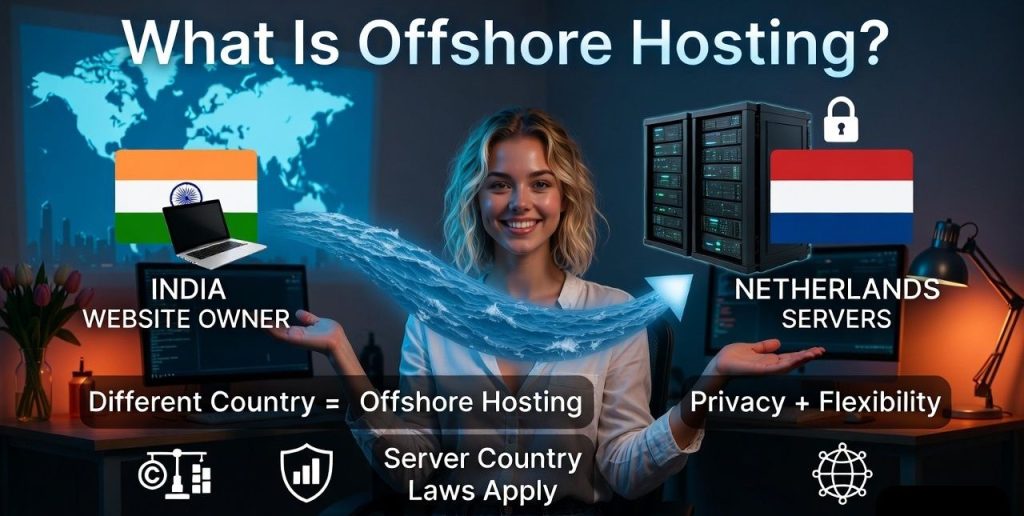
Because the physical server sits outside India, the website is considered to be hosted offshore, even though visitors from anywhere in the world can still reach it normally.
The core distinction between regular hosting and offshore hosting comes down to jurisdiction. A website hosted offshore is generally governed by the laws of the country where the server physically resides, not the laws of the country where the owner lives or runs their business. That single difference in jurisdiction is what drives almost every reason people choose offshore hosting in the first place, from stronger privacy protections to more flexible content policies.
It’s worth being clear about one thing upfront: offshore hosting does not mean a website becomes untouchable or exempt from all laws. It means the website operates under a different legal framework, one that may be more favorable depending on the situation, but is still a real legal framework with its own rules.
How Offshore Hosting Works?
Offshore hosting works the same way technically as any other form of web hosting. A hosting company owns or leases servers, installs an operating system and control panel, and rents out server resources to clients. The main differences are where those servers sit physically and which country’s laws apply to the data stored on them.
1. Server Location and Data Centers
Offshore hosting providers operate servers inside professional data centers located outside the client’s home country. These facilities typically include redundant power systems, climate-controlled server rooms, fire suppression systems, and physical security measures such as biometric access and round-the-clock surveillance. The quality of the data center matters just as much as the country it’s located in, since a poorly built facility in a privacy-friendly country still results in unreliable hosting.
2. Hosting Provider Infrastructure
Just like domestic hosting companies, offshore providers offer shared hosting, VPS hosting, dedicated servers, and cloud hosting. These servers store website files, databases, email accounts, and applications, and are managed through the same familiar tools such as cPanel, Plesk, or custom control panels.
3. Network Connectivity and Speed
A website hosted offshore is delivered to visitors through the same global internet backbone as any other website. However, physical distance does introduce latency. A visitor located far from the server will typically experience slightly slower load times than a visitor located close to it. Many offshore hosting providers address this by connecting their data centers to major internet exchange points and by supporting content delivery networks (CDNs), which cache website content on servers closer to visitors around the world and largely offset the distance-related slowdown.
4. Data Storage and Jurisdiction
Once files and databases are stored on the offshore server, they become subject to the data protection, censorship, and disclosure laws of that country. This is the practical mechanism behind most offshore hosting benefits: the data itself hasn’t changed, but the legal rules governing who can access it, and under what circumstances, have.
Why Website Owners Choose Offshore Hosting?
Several distinct motivations drive website owners toward offshore hosting, and most users have more than one reason.
- Privacy protection. Some offshore hosting providers operate in countries with strong data privacy laws and limited government surveillance powers. These environments can offer meaningfully better protection for both the website owner’s information and their users’ data.
- Different regulatory environments. Every country enforces its own rules around online content, data retention, and copyright takedown procedures. Offshore hosting lets website owners operate under a legal framework that may be less restrictive or better suited to their type of content.
- Content flexibility. Certain offshore providers apply more lenient content policies than mainstream hosting companies, which is why offshore hosting is often associated with what’s commonly called DMCA-ignored hosting. It’s worth noting this does not mean illegal content is permitted; it typically means copyright takedown requests are handled differently or are not automatically honored the way they would be in the United States.
- International business operations and performance. Businesses with a global customer base sometimes host closer to their actual audience rather than their headquarters, improving load times and user experience in the regions that matter most to them.
- Business continuity and risk diversification. Some companies deliberately spread their infrastructure across multiple countries so that a legal dispute, regulatory action, or local outage in one jurisdiction doesn’t take their entire online presence offline.
Popular Countries for Offshore Hosting
Certain countries have become known hubs for offshore hosting because of a combination of strong infrastructure, favorable laws, or both.
- Netherlands. Home to one of the largest and most developed internet infrastructures in Europe, including major international internet exchanges. It offers a strong balance of connectivity, legal stability, and data privacy protections, making it one of the most commonly chosen offshore locations.
- Iceland. Known for strict privacy legislation and data centers powered almost entirely by renewable geothermal and hydroelectric energy. Its naturally cold climate also reduces cooling costs, which can translate into more competitive pricing.
- Switzerland. Recognized worldwide for political neutrality and some of the strictest data protection laws in existence. Swiss data centers sit outside major intelligence-sharing arrangements, which appeals to businesses handling especially sensitive information.
- Hong Kong. A long-established hub for internet infrastructure in Asia, offering strong connectivity and low latency for audiences across the Asia-Pacific region.
- Panama. Popular for its lack of mandatory data retention requirements and limited data-sharing agreements with other governments, which makes it attractive to businesses that prioritize anonymity.
- Seychelles. A smaller but growing offshore hub, often paired with offshore company registration, and known for minimal reporting requirements and a business-friendly regulatory stance.
- Russia and Eastern Europe. Some providers in this region offer offshore VPS and dedicated hosting with relatively relaxed content enforcement, though infrastructure quality and support standards vary considerably between providers.
It’s important to remember that not every hosting company operating out of these countries actually provides offshore-style privacy or content flexibility. The country is only half the equation; the provider’s own policies and practices matter just as much.
Types of Offshore Hosting Services
Offshore hosting providers generally offer the same range of service tiers as domestic hosts, scaled to different levels of traffic and control.
- Offshore shared hosting. Multiple websites share the resources of a single server. This is the most affordable entry point and is generally suited to small websites, blogs, and low-traffic projects rather than anything data-sensitive.
- Offshore VPS hosting. A Virtual Private Server allocates dedicated resources within a virtualized environment on a shared physical machine. It offers considerably more control, better performance isolation, and often root access, without the cost of a full dedicated server.
- Offshore dedicated servers. The client gets exclusive use of an entire physical server. This tier suits high-traffic websites, applications with heavy resource demands, or businesses that need full control over server configuration and software.
- Offshore cloud hosting. Workloads are distributed across multiple connected servers rather than a single machine, improving scalability and uptime resilience since traffic can shift automatically if one server experiences issues.
- Offshore dedicated IP and anonymous hosting. Some providers offer plans built specifically around minimizing traceability, including private WHOIS registration, anonymous payment options such as cryptocurrency, and dedicated IP addresses not shared across multiple clients. These plans are aimed squarely at privacy-first users rather than general-purpose hosting.
Offshore Hosting vs Offshore Colocation
These two terms get mixed up often, and the difference matters when deciding what to actually sign up for.
With offshore hosting, the provider owns the physical server and simply rents you capacity on it, whether that’s shared space, a VPS slice, or an entire dedicated machine. You never touch the hardware; you just manage your website or application remotely.
With offshore colocation, you own the physical server yourself and ship it to a data center abroad, where the provider only supplies the rack space, power, cooling, and network connection. Colocation gives you complete control over the exact hardware specification but adds the complexity of international shipping, customs paperwork, and physically maintaining equipment you can’t walk up to.
For most website owners, offshore hosting is the simpler and faster route to get online. Colocation only makes sense if there’s a specific hardware requirement, existing equipment to reuse, or a compliance reason that demands physical ownership of the machine itself.
Offshore Hosting vs Regular Hosting
| Feature | Regular Hosting | Offshore Hosting |
| Server location | Same country or region as the owner | Different country, chosen deliberately |
| Legal jurisdiction | Local laws apply | Foreign laws apply |
| Privacy protections | Standard, varies by local regulation | Often stronger, depending on the country |
| Content restrictions | Usually stricter enforcement | Often more flexible |
| Setup speed | Typically fast, familiar process | Similar, though verification may take longer |
| Payment options | Wide range, including local methods | Often narrower; crypto is common |
| Latency for local visitors | Low | Can be higher unless a CDN is used |
| International reach | Limited without extra setup | Common, especially with global providers |
These differences explain why some site owners choose offshore hosting even though it can mean a small trade-off in latency or payment convenience.
Advantages & Disadvantages of Offshore Hosting
| Advantages | Disadvantages |
|---|---|
| Greater privacy. Certain offshore jurisdictions place strict limits on how much data a hosting provider can be compelled to disclose, offering stronger protection for both website owners and their users. | Legal complexity. Operating across international jurisdictions can create confusion around which country’s copyright, data protection, or consumer protection laws actually apply, especially if the business also serves customers in stricter countries. |
| A different legal environment. Businesses can operate under regulations that may be less restrictive or better aligned with their industry than the laws back home. | Cross-border data compliance risk. If a business handles data from users in regions with strict regulations, such as the EU’s GDPR, hosting offshore does not exempt it from those rules. The business may still need to meet those requirements regardless of where the server sits. |
| Global-grade infrastructure. Many offshore hosting providers operate out of major international data centers with strong network connectivity, redundant power, and enterprise-level uptime. | Customer support differences. Support quality, response times, and even language availability can vary significantly between offshore providers, particularly smaller ones. |
| Better fit for international projects. Websites serving a global audience can benefit from being hosted in a region with strong connectivity to multiple continents rather than being tied to a single country’s network. | Payment limitations. Some offshore hosting companies accept a narrower range of payment methods compared to mainstream providers, though many now support cryptocurrency as an alternative. |
| Flexible content policies. Certain types of legal but restricted content, such as adult entertainment, gambling, or file-sharing platforms, are easier to host without facing takedown pressure. | Latency for local audiences. If most of a website’s actual visitors are based in the owner’s home country, hosting far away can slightly increase load times unless mitigated with a CDN. |
| Resilience through diversification. Spreading infrastructure across jurisdictions reduces the risk of a single country’s legal or political action disrupting an entire online business. | Inconsistent provider reputation. Not every offshore hosting company maintains the same standards of reliability, transparency, or infrastructure quality, and the offshore hosting space has historically attracted a mix of both excellent and unreliable providers. |
The real-world benefits of offshore hosting depend heavily on the specific provider and country, but the general advantages include:
What Does Offshore Hosting Typically Cost?
Offshore hosting pricing generally follows the same structure as domestic hosting, scaled by service tier. Shared offshore hosting plans are usually the cheapest option and can start at just a few dollars per month, aimed at small sites with modest traffic.
Offshore VPS plans cost more, reflecting dedicated CPU, RAM, and storage allocations, and pricing typically increases with resource specifications. Offshore dedicated servers sit at the top of the pricing scale, since the client gets an entire physical machine, and prices vary widely based on hardware specifications and the data center’s location.
A few pricing details are worth watching for specifically with offshore providers: bandwidth overage charges, the availability of a dedicated IP address as a separate line item, and whether DDoS protection is included by default or sold as an add-on.
Because offshore hosting is often chosen for content resilience, DDoS protection in particular is worth confirming before signing up, since privacy-friendly or content-flexible sites are sometimes more likely to attract malicious traffic.
Is Offshore Hosting Legal?
Offshore hosting itself is legal in the vast majority of cases. Hosting companies operate within countries where they are properly licensed to provide these services, and renting server space abroad is not, by itself, an illegal act anywhere.
That said, the legality of the content on those servers depends on the laws of the country where the servers are physically located, and website owners remain responsible for ensuring their content complies with those regulations. Choosing an offshore jurisdiction does not create a legal loophole for content that’s illegal everywhere, such as fraud, malware distribution, or other cybercrime, which remain prohibited in essentially every jurisdiction worldwide.
It’s also worth remembering that hosting offshore doesn’t automatically remove obligations under the laws of the website owner’s own country. A business based in a country with strict data protection or consumer laws generally still has to follow them, regardless of where its servers happen to sit.
Who Typically Uses Offshore Hosting?
A wide range of organizations and individuals rely on offshore hosting, including:
- International businesses seeking better connectivity to specific regions
- Privacy-focused websites and services that prioritize user anonymity
- Data archiving and backup projects that need geographic diversification
- Content publishing platforms operating in countries with heavy censorship
- Global online communities and forums with a distributed user base
- Businesses in legally gray or restricted industries, such as gambling or adult content platforms, that face stricter hosting terms domestically
- Companies that intentionally diversify server locations to improve overall service availability and reduce single-point-of-failure risk
How to Choose a Reliable Offshore Hosting Provider?
Selecting a trustworthy offshore hosting provider takes more diligence than picking a domestic one, simply because there’s less regulatory oversight to fall back on if something goes wrong. Key factors to evaluate include:
- Server location transparency. A reliable provider should clearly state exactly where its data centers are located, rather than being vague about jurisdiction.
- Infrastructure quality. Look for professional data centers with strong network connectivity, redundant power, and clear uptime guarantees backed by a formal SLA, ideally 99.9% or higher.
- Privacy policies. Review what data the provider collects, how long it retains logs, and under what circumstances it would disclose customer information.
- Content and DMCA policy clarity. A trustworthy offshore provider should be upfront about exactly what content is and isn’t permitted, rather than making vague promises of unlimited freedom.
- DDoS protection. Confirm whether protection is included by default, since this matters more for offshore hosting than for typical domestic setups.
- Payment method support. Check whether the provider supports convenient and secure payment options, including whether cryptocurrency payments are available for added privacy.
- Customer support responsiveness. Test support channels before committing, and check whether assistance is available in a language and time zone that works for you.
- Reputation and independent reviews. Research the provider’s track record through independent reviews and community discussions rather than relying solely on testimonials on their own website.
Frequently Asked Questions
1. Is offshore hosting more expensive than regular hosting?
Not necessarily. Entry-level offshore shared hosting is often priced similarly to domestic shared hosting. Costs tend to rise at the VPS and dedicated server tiers, largely due to the resource specifications chosen rather than the offshore location itself.
2. Will offshore hosting slow down my website?
It can, if most of your visitors are located far from the server and no CDN is used. Using a content delivery network largely eliminates this concern by caching your site closer to visitors worldwide.
3. Can I host any type of content offshore?
No. Offshore hosting offers more flexible content policies in many cases, but illegal content, such as material involving fraud, malware, or child exploitation, remains prohibited everywhere regardless of server location.
4. Do I need my own hardware for offshore hosting?
No. Unlike offshore colocation, offshore hosting means the provider owns and maintains the physical server. You simply rent hosting resources and manage your website remotely.
5. Does offshore hosting protect me from all legal obligations in my home country?
No. Hosting offshore changes which country’s server-level laws apply, but it doesn’t remove obligations your business may still have under the laws of the country where you operate or where your customers are located.
6. How do I verify an offshore hosting provider is trustworthy before signing up?
Check independent reviews, confirm their data center location and uptime track record, read their privacy and content policies in detail, and test their customer support responsiveness with a pre-sales question before committing to a plan.
Conclusion
Offshore hosting means placing a website on servers located in a country other than the owner’s home country, which shifts the legal framework governing that data to the hosting country’s laws rather than the owner’s own.
Businesses and individuals turn to offshore hosting for a mix of reasons: stronger privacy protections, more flexible content policies, better connectivity for international audiences, and greater resilience against single-jurisdiction legal risk. At the same time, it comes with real trade-offs, including potential latency for local visitors, narrower payment options, and the need for extra diligence when it comes to legal compliance and provider reputation.
Offshore hosting is not a shortcut around the law, and it’s not automatically better than domestic hosting for every use case. It’s a genuinely useful tool when the reasons for choosing it, privacy, jurisdiction, content policy, or global reach, actually match what a specific website or business needs. Taking the time to understand how it works, weigh the advantages against the disadvantages, and carefully vet a provider is what separates a well-planned offshore hosting setup from a risky one.




2 Comments